Friday, May 6, 2011

Electric Race Update: CAFE-Bound!

Picking up my electric aircraft coverage again with an email from Phoenix Air USA kingpin Jim Lee with the latest updates on the PhoEnix electric motorglider NASA/CAFE race entry, which just came out of the paint shop and has all its pretty parts put together...and a beautimous bird she is indeed.
Built for slipping through the air: the PhoEnix electric motorglider.
"We put the PhoEnix together," Jim tells me, "my last day in Czech so we could finally see what it looks like.  Man am I excited now!  I can't believe that I will be the one to fly such an amazing ship."
Color me green with envy.  
Jim's deep and broad soaring background should stand him in good stead tweaking every last ounce of performance from the gorgeous, one-off soaring bird.
He's also got a few more details on his Phoenix blog.  Here are some highlights: 


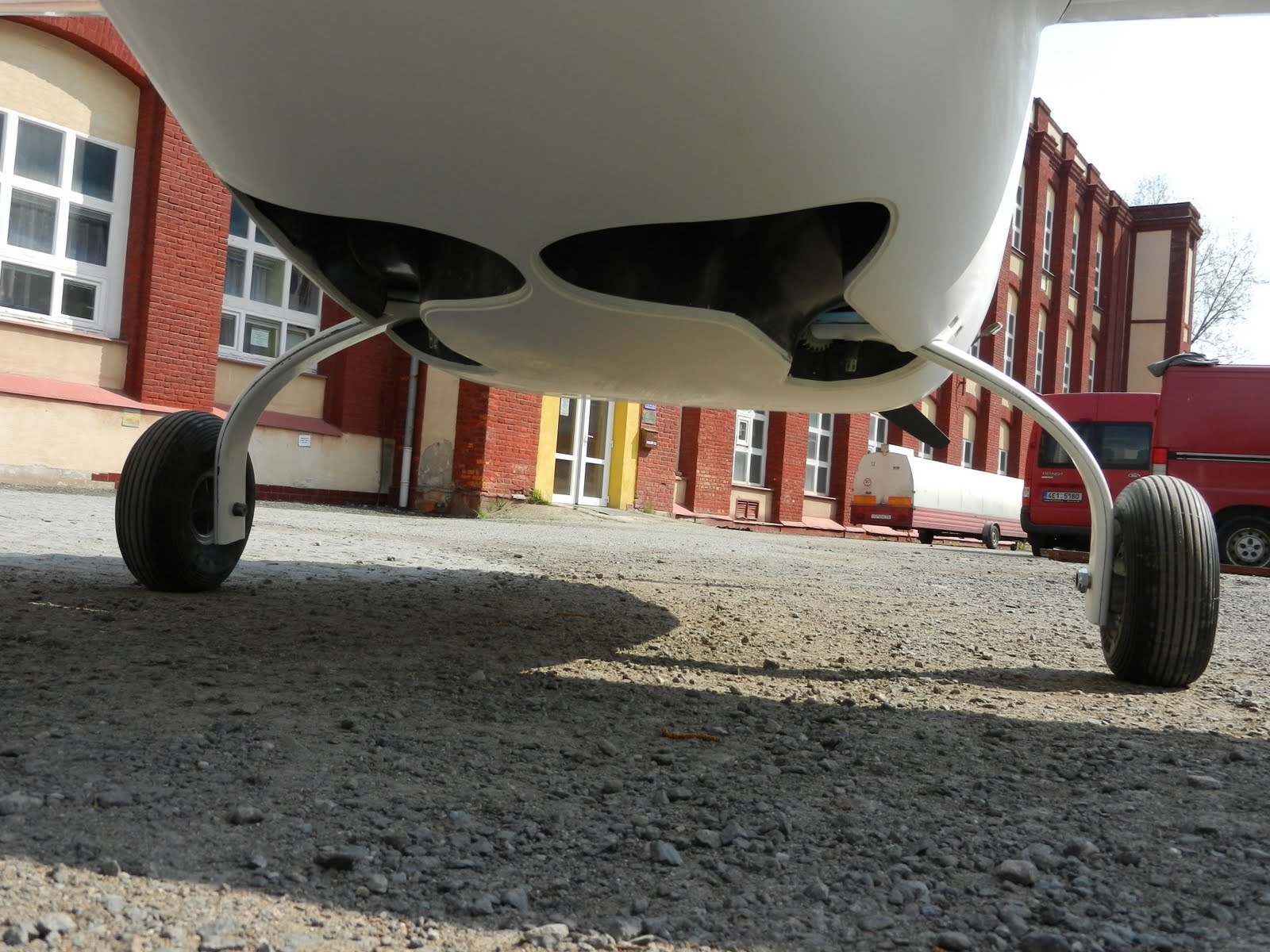
View from tail: Gear retracts up into normal baggage area.

Conceived for the NASA CAFE Green Flight Challenge..."A race that offers big bucks for the winner ($1.65 million total), but with a bar set so high that it is unlikely that anyone will win it. But if any aircraft can do it, the PhoEnix can!"
Electric motor installation.


Check out that shadow for a sense of the high aspect ratio.  Photo: Jim Lee

[] A modified Schempp- Hirth Discus wing installed as a shoulder wing to make room for the 
retractible gear. 
[] Gear electrically driven.  Swings back into the wheel wells (the baggage compartment of the original Phoenix.)
Photo courtesy Jim Lee
 [] wings 14.5M (47.5 ft.) span, optimized for the 100mph minimum required speed for the 200 mile race course.
[] race begins July 10 no. of San Francisco. 

Next post, I'll have a rundown, with pictures, of one of the PhoEnix's top competitors, the Pipistrel Taurus 4 twin-fuselage electric racer!


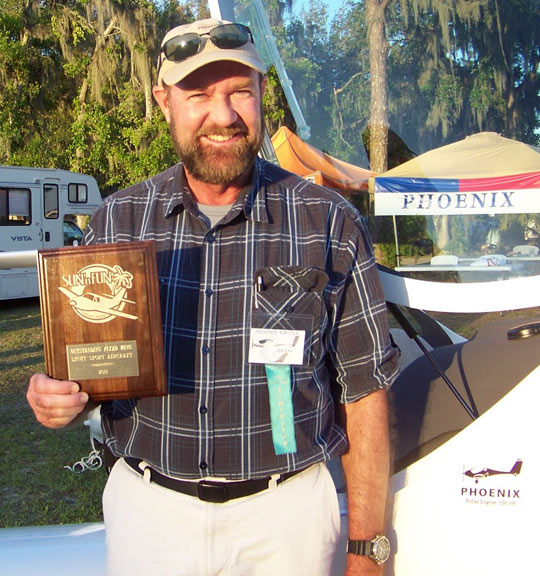
And here's Jim beaming at the end of Sun 'n Fun last month after receiving the Outstanding Fixed Wing Light Sport Aircraft Award.  
Congrats James, it's a worthy winner for sure!


Wednesday, May 4, 2011

Flight Design 4-Seater Heading To Market

Although this isn't an LSA story per se, it comes out of Flight Design, the top-notch, top-selling LSA company in America, so I thought you'd be interested to know the company debuted its C4 4-seater at AERO last month and just came out today with some pricing and delivery numbers along with some specs.
Perhaps the most interesting number to me is the $250,000 "target" price for the American market, along with a  €220.000 price for Europe and the rest of the world outside the U.S.
When's the last time we saw a new, state-of-the-art 4-seat airplane at a price close to that?
Also noteworthy is the minimal disparity between the overseas and U.S. prices, reflecting the company's desire to minimize (yea verily, to almost negate!) the currently soaring euro/dollar exchange rate imbalance.
Artist's rendering of the C4.  It's not your grandfather's CTLS.  Image courtesy Flight Design.

Some interesting details about the all-carbon fiber composite airplane:
[] Engine choice: two engine options to best suit fuel availability and cost in the owner's region: either a traditional aviation engine that can run on auto fuel, or a turbo diesel engine that burns Jet A fuel. Actual engine brands have yet to be finalized. 
[] Avionics suppliers are still being firmed up as well. 
[] First Delivery:  Set for 2013
[] Early Bird Buyers:  At AERO, more than 30 C4 orders were taken.  Orders and deposits are now accepted online or through Flight Design's worldwide network of dealers.
[] Specifications: (subject to flight test confirmations) include useful load of 1,320 lbs.;
[] maximum take-off weight of 1.200 kilograms (2,640 pounds);
[] max cruise of 160 knots @ 6,000 feet MSL.
[] Range of 1,200 nautical miles with the avgas engine at 65% power or...
[] 1,700 nautical miles with the diesel engine at 55% power;
[] Fuel capacity: 70 gal.
[] Cockpit dimensions: 52" wide, 47" at rear seat, head clearance in rear for a 6' 7" passenger.
C4 mockup at AERO.  Photo courtesy Loop Magazine
Matthias Betsch, CEO of Flight Design, says this:
"Our ongoing customer surveying shows us that price tops the demand list from customers and we believe our prices can result in sales volumes of 200 to 500 aircraft per year."
As I've noted here before, if you'd like to put in your $.02 in the design/configuration process, you can still do that as the final design is still in flux: Go here for the survey.
You might even win a Garmin aera 500 GPS for your trouble.
Flight Design plans to certify the C4 to several international standards ensuring compliance with both EASA and FAA regulations.
The German company has already successfully gone through several rigors including LAMA and ISO audits.  It also just gained EASA Design Organization Approval that permits it to progress on its own schedule with only oversight monitoring from EASA, which minimizes a lot of cost and time drag on the process.
Best of success to this progressive company which has done so much to help establish the LSA movement in America with its quality aircraft and broad and growing sales and service network.

Wednesday, April 27, 2011

"Spy Network" Report: Twin Electric Sailplane

NOTE:  Below you'll see a comment asserting that members of the Pipistrel Taurus Electro team visited the PhoEnix project because they were having some difficulties with the Twin Taurus.
I've since heard from Tine Tomazic of Pipistrel's Research and Development team, who wished to correct Jim's false impression and wrote:  "
"The visit to PhoenixAir was a private visit to Martin Stepanek who runs PhoenixAir on HIS INVITATION, nothing else."
Duly noted and corrected and I wish Pipistrel all good luck with their exciting twin Taurus project.
We now return you to our regularly scheduled blogcast:

I heard again today from Jim Lee who's still overseas helping prep the PhoEnix electric motorglider for July's big, $1.65 million CAFE Green Flight Challenge (GFC) fuel-efficient flight competition in Santa Rosa, CA.
Jim sent along photos of the electric nosecone with integrated feathering prop/spinner assembly.  First test flights of the PhoEnix are planned in a couple weeks.
BTW, the enhanced streamlining afforded by the much smaller e-motor boots the lovely creature's performance from L/D 32:1 to 36:1 -- a 12.5% increase!  That's great for soaring and also means less power required to sustain flight, the Big Picture for endurance at this stage of electric aviation. 
The GFC PhoEnix entry will be powered by a 44 kW motor and controller developed in house by Phoenix Air.
Lipo (lithium polymer) batteries, popularized by the RC model industry for their light weight and high storage capacity, will hold the electric "gas".
I'd asked Jim earlier how they were going to get the airplane over, joking that perhaps they'd ferry it across.  You'll see his wry response below.
Note also his take on the cooperation between Pipistrel's Taurus Electro team, also entered in the Green Flight Challenge, and the PhoEnix team.  This brings back fond memories of the dawn of hang gliding, ultralight, then LSA flight, where pilots helped out fellow pilots because the goal was to share the joy and accomplishments with as many people as possible.
PhoEnix's feathering prop, standard on Rotax SLSA too. Photos: Jim Lee


 Once flight contests and market competition ramped up, that "one-for-all" spirit dwindled, as it inevitably does.
Yet I'm mindful of the spirit of mutual support and shared enthusiasm that exists today in the LSA industry, where entrepreneur/pilots like Bill Canino of SportAir USA, Tom Peghiny of Flight Design and Dave Graham of Legend Cub, each with a distinctly different flying background, regularly help out their fellow pilots even though they're all in competition for a small pool of sales dollars.
The recent Georgia LSA Tour is a great example, I'll have an update on that soon.
So here's that fraternal spirit again with the PhoEnix team helping out the Pipistrel team.  Even if it is too late to steal ideas, they certainly don't have to help one another, especially with all those greenbacks at stake. 
Makes you want to rethink this whole competition thing from top to bottom, doesn't it?  
Here's Jim's email:
"Mornin James,
I have enclosed a spy drawing of the Pipistrel entrant to the GFC.  Two Taurus joined together by a center wing a la Twin Mustang of WWII fame.  Pretty interesting, eh?  The Pipistel boys visited us a few days ago to look at our design because they are having trouble with theirs.  Anyway, from their description we put together this drawing.  Everyone realizes that it is too late in the game to copy each other and the prize is too hard to win so cooperation is in order.
"
PhoenixAir's speculation of what Pipistrel's special Taurus Electro looks like.  Photo: Jim Lee
Jim went on to answer a question I had about flying the PhoEnix which, unlike the SLSA version, has retractable main gear to optimize performance.  Jim had brushed me up (I'm a lazy FAR reader) on the FAA regs, which allow a person with only a glider rating to fly a self-launching (powered) sailplane without a flight medical.  This time, I asked him whether the same allowance held for a retractable-gear glider, and here's his reply:
"There are only 3 logbook endorsements with the glider rating: self-launch, aerotow, and ground launch.  Practically every glider is a taildragger for decreased drag (except for a few oddballs).  Most gliders have retractable gear.  Many are "high-performance".  Some have variable pitch or folding or feathering props.  There are no endorsements for any of this as there are with airplanes.  So a glider rated pilot with a self-launch endorsement can fly a retract motorglider."
PhoEnix after getting it's new coat of paint.  Photo: Jim Lee
And finally Jim's tongue-in-cheek response to my question about bringing the PhoEnix to California for the GFC in July:
"We will fly the PhoEnix across the Atlantic east to west.  We don't have quite enough battery storage to make the whole flight, so we will have to soar a container ship across.  We are looking into sailing schedules out of Bremerhaven now.  The GFC will be a piece of cake once we do this! :-)
Regards,
Jim"
Thanks again Jim for giving us an inside look to what I very much believe will be an historic event.

Monday, April 25, 2011

PhoEnix : E as in Electric

Scoop time!
I've been having so much fun lately writing the electric flight article (now rescheduled to Aug. issue of Plane & Pilot) that it's bringing electrifying news from the universe to my email inbox.
Jim Lee, that hard working, happy-flying distributor for the Phoenix motorglider I was gobsmacked with at Sebring, told me today about the PhoEnix all-electric version of the Rotax-powered motorglider that is selling like hotcakes here and abroad.
 Here's some of what he had to say:
"Reporting from the Czech Republic where I am spending 2 weeks assisting in the production of our new electric PhoEnix.  The weather has been great ... soaring 5.5 hours in the last two days...I see that your blog has sort of turned into an electric blog lately, so that gave me the idea to report to you first on our electric project...Orders for the Rotax Phoenix are pouring in, so we had better stop flying and start working."
Oh, for that challenge: to fly, or handle orders for your aircraft! 


Here are excerpts from the blurb Jim sent:
[] The Phoenix S-LSA glider just won the 2011 Sun 'n Fun Outstanding Fixed Wing LSA award (and congratulations to all, Jim!)
[] The PhoEnix has retractable gear, variable pitch propeller, a modified Discus wing, and a new super streamlined fuselage. (check out the pix!)
[] The prototype PhoEnix debuted at Aero Freidrichshafen in 2010.
[] PhoEnix proto number two is about to begin first test flights! 
[] "Phoenix Air believes that the attributes of the PhoEnix will give it the winning edge in the Green Flight Challenge."
Check the Challenge link above, or here's the short tell:
Team aircraft must fly 200 miles in under two hours using the energy equivalent of one gallon of gas per occupant.
So far, 13 teams have entered, including Jim Lee in the PhoEnix.  Not all will show.
Location: Sonoma Co. Airport, Santa Rosa, CA, and don't I wish I still lived in Santa Barbara so I could go!
Date: July 11-17, 2011.
The Kicker: Prize money is $1.65 million!  Sponsored by NASA, which wisely realizes there are lots of innovations coming directly from grass roots aviation and it wants to cull the best.
PC Aero Elektra One
Some of the competitors:
[] Greg Cole/Windward Performance's Goshawk, a 50-foot span electric two-seater
[] PC Aero's LEAP award winning Elektra One, single seat electric
[] Scott Sanford/Yuneec is listed with the E1000, 4-seat electric, but don't expect to see that as the company's President Tian Yu just announced it at AERO and there's been no word of even a mockup, much less a prototype...although wouldn't it be super cagey for it to show up with four people on board, (which would allow the energy equivalent of 4 gallons of fuel?)
[] Eric Raymond (known for Sunseeker solar-powered sailplanes) with the eGenius two-seat electric sponsored by Airbus.
[] The Taurus Elektro G4, four-seat electric.  It's doubtful whether this will show either...but you can see the trend in thinking that four seaters sooner rather than later is an important goal.
Clearly, the minimal battery storage capacity of current technology is not diminishing enthusiasm...not to overlook the go-for-it stimulus of a 1.65 megabuck prize either.
Good luck all!  This ought to be a history-making event.

Saturday, April 23, 2011

Getting a Charge

LEAP award winner Elektra One. photo courtesy PC-Aero GmbH
Well, Thomas, you've done it again: gotten me to blather on so long with your as-always thoughtful and knowledgeable comments that I exceeded the comment buffer so have to palaver on here in another post.
Well, that's why they call it a weBlog I guess: it's a place to hang our thoughts out to dry.
So what's below is a response to your comment from yesterday's post, with a couple more pix thrown in to thump the eye candy factor.
I think we can't overlook the market factor here.  Just as car manufacturers know where the buyers are, it could be what we're seeing with these projects aiming toward higher/faster/more payload electric are manufacturers figuring that they're since they're going to sell more of the expensive, travel-capable airplanes than sailplanes and motorgliders anyway, why concentrate time and resources on a transient, historically tiny share of the market?  Leapfrog to the future, expect the tech to come along as needed.

If I'm right, it's a visionary way to jumpstart an entire new genre, a new epic in fact, of flight.
And since I don't profess to be an expert, I'm just observing it like you are and wondering myself exactly which way and ways it will go.
Your NASA reference is intriguing.  I'd like to talk with some electrical bigbrains for enlightenment on the concept as I hadn't heard that. 
It could very well be that there's an "economy of weight", like economies of scale in manufacturing, that comes into play beyond a gross weight threshold, given the current technology.
HYNOV aircraft - first to fly 100% on hydrogen. Photo: Gerard Thevenot
 Still, Randall Fishman is quite unequivocal about it: he says he's crunched the numbers and has no doubt that the heavier the airplane and the poorer the pure aerodynamic efficiency, the less electric power makes sense, given the capacities we have today. 
I'll save myself from being thought a fool by opening my mouth and removing all doubt, by continuing to watch for what actually comes to market and extrapolating possible futures from that, as we've all begun doing to date.
I do believe we will see 4-seaters like Yuneec is currently promising.
When? 
Battery advances will surely determine, barring some other superspiffy technology coming in that nobody expects, such as some super solar cell.
Energy storage remains the holy grail from what I hear and read everywhere.
I also believe Yuneec has learned very well how to gin up enthusiasm, but it may well be true, like the flying car people, that they're simply making sure their name stays out there in public view, knowing  full well they'd be making an epic mistake by pushing out "vapor wings", i.e. aircraft that aren't really refined and truly ready for the market.
Antares DLR H2 fuel cell power: Photo: DLR-Institut für Technische Thermodynamik, Lange Research Aircraft GmbH
They can't fail to have noticed the Billion Dollar Debacle of VLJ, the Very Light Jet, as envisioned by Eclipse, which went down the drain and took most of the other swimmers with it. 
VLJ was trumpeted as the next great thing, the savior of smaller airports, the harbinger of a vast new regional "air taxi" network that would make short- and medium-distance travel more practical by  helping many of us, especially businessfolk, avoid the hassles of big airline terminal travel.
Problem was, the idea was not economically practical as conceived, and few VLJ will ever make it to market.
Yuneec has a lot of money and is at the vanguard of an entire new industry that they're helping to create, and surely hope to cash in on with lots of sales.
And clearly they're not rushing anything to market.  I wondered if they were having technical problems.  But the word I get from Yuneec insiders is they are not going to risk all that potential by rushing anything to market until it is thoroughly wrung out and ready for John Q. (Litigation-Capable) Public to fly safely and enthusiastically.
Fascination Ekarus, electric power.  Photo by W. Dallach
Remember when the iPhone came out?  That was a well-refined product.  I remember seeing the first commercials with the finger flick-scrolling from page to program, and thinking, "Yeah, right, just another bogus advertising hype."
Then I saw one some eager owner couldn't wait to share with me and anyone else within earshot.
I bought one as soon as I could and have never regretted it.  History changed with that product, just as it will with well-produced electric aircraft.
Two- and four-seat electrics are in our near future, we can hope, along with practical, affordable dlectric cars. 
In the meantime, there's a much broader technology to grow, and we're so clearly very much in the early Wright Years, so my guess is Moore's Law of computer tech proliferation (doubling every 18 months I think it is) will not likely happen just yet. 
There's still an entire, and basic, infrastructure to create and develop.  There are economies of scale to create first to make them affordable.
So that leads me back to concluding that for those of us who really want to fly behind (or in front of) an electric propulsion unit, we're better off for the next five years flying what I espoused above: light, efficient glider-style aircraft.
We shouldn't expect the moon just yet...but we can sure jump in and join the party, rather than gripe that we're not really saving money or going as far as we can with gas airplanes.
That's not the point in this stage of history, not the point at all.
Would I love to be dead wrong?  Would I welcome a two-seat, 2-3 hour electric 100 knot cruiser next lonth?  That didn't cost $150,000, but more like $40-50,000?   
You bet I would. 
And maybe we'll see it happen.
That's part of the fun: we get to watch it happen, all of us, and be a part of it as it unfolds.

Friday, April 22, 2011

Electric Flight: More Thoughts

Yesterday a reader commented on my electric flight post, specifically about the LZ FES, a pretty sexy add-on that just won the Lindbergh LEAP prize for best new electric propulsion system.  He wondered whether electric flight for now required light weight motorgliders or whether heavier, 15M plus sailplanes/motorgliders would be workable for electric power.
My answer began to get too lengthy to stick in comments so I'm posting it here, and thanks Thomas for your enthusiasm.

I talked over this very subject this week with Randall Fishman, the award-winning electric flight pioneer.  His take on where we're at right now is in my Profiles in Vision column, coming in the July issue of P&P.
Randall's whole trip is to get people up in the air with electric power right now, and not for 150,000 clams either.  To summarize his own one-man research and development plan, it's all about lightweight motorgliders.
There are two key factors -- light weight and a good low sink rate.  The less power you need to get airborne and maintain flight, the better contemporary electric flight technology works.
Randall hopes to debut his latest design, a composite two-seat LSA called ElectraFlyer X, at Oshkosh this year.  It's a very cool looking airplane...and a motorglider.
Previously, as I've noted here more than once, he rocked the electric world with the ElectraFlyer Trike, currently available for sale, and the prototype ElectraFlyer C, a single-seat model (more below). He's also in test mode with newly designed motors he's had built for the X and other projects.
There are lots of other electric motorglider projects out there, for this basic reason: the less amount of thrust you need to stay airborne, the more viable electric propulsion is.  For now that has to mean less transportation-style flying and more "pure enjoyment" local flying.
Can we live with that?  Hell yes...how cool is it that we are able to fly this completely revolutionary technology right now?
My favorite story of Randall's recounts the time he took his electric trike off from Ellenville, NY's little airport, motored over to where the hang glider guys were soaring the popular ridge a couple miles away, turned off the motor and joined the thermaling gaggles.
Typically, and I've done this myself, you work up into ever-stronger lift bands at E-Ville by ramping  up the sloping ridge, which can get you good and high but also back half a mile or more from launch.
That particular day, some guys were way high but way back.  Randall, because he had the boost of electric power when he needed it, was able to penetrate out in front of the hill and catch some really strong lift that the pure soaring craft couldn't risk trying to reach for fear they'd land out from the LZ, the landing zone.

He flew two hours that day -- and landed with plenty of "juice" to spare.
This is one highly doable scenario for electric powered flight.  No, it's not 100 knot A-to-B flying, but we've got plenty of gas-powered aircraft for that already.
The Electric Swift.  Photo from Icaro.  No, that's not a tail, but a folding prop!
This is something new, but also old: flying again for the pure joy of it...without the many detriments of gas engines.
On a good soaring day, you can take a current-tech electric, whether it's a hang glider trike or a lightweight motorglider or a flying wing like the Swift at left, motor up into the lift, and fly as long as the lift holds out.  That's possible right now.
And to repeat my electric-flight mantra: no mess, no smell, dramatically less noise, no vibration, no annuals, no oil, no gas, long-life motors, rechargeable battery packs that cost under a buck to charge, and will last many hundreds of hours, and will get increasingly affordable as more people jump on the electric bandwagon, not just in the air but also for ground vehicles like cars, bikes and cycles.
We're in the beginning stages of a paradigm shift that will outlast all the greed-based attempts to forestall it.  It's here, it's growing, and it will be glorious.
Okay, down with the pom poms and back on topic.
There are more pure "muscle" electric aviation projects out there as well, of course.  Before those become reality, before the "higher, faster, more payload" visions become reality, battery efficiency will have to improve by a few scales of magnitude.
Electric Swift's cockpit view.  Photo courtesy Icaro.
So the answer to your question, Thomas, about electric powered flight right now, remains with lighter weight and more efficient airframes, and that spells motorgliders.
Bigger motorgliders will work but are more exotic and complex to deal with (trailers, special hangars, elaborate feathering/streamlining systems, and higher costs for sure.)
Meanwhile, the electric powered hang glider trikes that Randall and others have developed work, and work very well.
They serve up more than an hour of flight and don't require 130 lb. pilots to do so (Randall weighs 200 lbs. and has consistently had 1 1/2 hour and longer flights.)
Some other notable projects, including the video below, are popping up around the world.  Search for "electric trike" to get an idea.  Here's a link to get you started learning about various electric projects already for sale or imminent.

Let's take a closer look at Randall's ElectraFlyer C prototype (which he is selling for $49,000, see my earlier post).  The C is a single-seat, converted all- aluminum Monnett Moni motorglider he built from a kit.  And Randall also gets 1.5 hours and more on a full charge too, along with 70 mph cruise and 90+ mph top speed.
Manfred Ruehmer's electric trike (see video above).  Photo courtesy Icaro.
Yuneec is of course fine tuning its many electric projects.  Notable are several one- and two-seat motorglider frames, the e-Spyder ultralight, a trike, and a four-seat electric airplane just announced...and all are electric powered.
Some time pretty soon, certainly in the next year or so, we're going to have a lot of electric aircraft on the market, to suit a broad range of budgets.
This will not be solely another rich person's hobby, although it will take time to get the electric industry up and running because important technologies need to be developed and proofed, such as higher-storage batteries and more sophisticated, safe electronic motor controllers.
It is happening.  It is happening now.  We will be flying electric globally in a rich variety of planforms and applications before very much longer, you can count on it.
This year's Oshkosh, in particular, should bring more exposure and new electric aircraft to a broader audience.
Keep a lookout for my survey of electric flight projects around the world, also coming in the July issue of P&P.

Tuesday, April 19, 2011

LEAP Awards Electric Aviation Prizes

Eric Lindbergh, grandson of Charles A. Lindbergh, awarded the LEAP Prize to Pipistrel's Ivo Boscarol at the just-finished AERO General Aviation convention in Friedrichshafen, Germany.
The 3rd annual e-Flight gathering took place there also, and Lindbergh's Best Electric Aircraft award went to Pipistrel's Taurus Electro.
There were some notable challengers in the category and three finalists: the Taurus, the Electric Cri-Cri (power by Electravia), and Eric Raymond's Sunseeker II solar airplane.
Also awarded was the Best Electric Propulsion.  The two finalists were the LZ Design FES (Front Engine Sustainer) system and the Rapid 200 Fuel Cell propulsion system from Polytechnic Torino.
The LZ FES was the winner -- check out this video.

The LEAP 2011 Outstanding Achievement Award went to Bertrand Piccard, Andre Borschberg and the Solar Impulse Team for its electric around-the-world project airplane. 

A romantic, and apt, spin on the awards is linking today's electric pioneers to Lucky Lindy's amazing transatlantic flight in 1927, which pretty much singlehandedly changed the global perception of aviation from a daredevil hobby or foolhardy mail delivery system to the common transportation, recreational and warfare tool it has become. 
It may be years before there is a viable non-motorglider style electric aircraft.  Battery density advances are needed, since gasoline still has more than 70 times the energy per pound of the best commercially available batteries today.
But...it's coming, and publicity-rich enterprises like the LEAP award are helping fuel public acceptance of the new technology.  Meanwhile, we can all have fun thinking about flying for pure enjoyment...on near-silent propulsion.
And congratulations to all the winners, including Pipistrel for the Taurus Electro, which is the first commercially available electric two-seater aircraft in production. And it sells with a Solar Trailer, which charges the batteries with sun power while the bird is stored. 
Kinda cool.