Thursday, July 2, 2009

The Power of Breathing

The Power of Breathing
By Dr. RandyBorum

(Article first appeared in Black Belt Magazine, July, 2009)

Author's Note: This article marks the end of Black Belt Magazine's "Psyched!" column. It has been a pleasure writing for them the past couple of years, and I appreciate the opportunity to share information on sport psychology with fighters and martial artists. Thanks, also, to all of you who read the column. - RB

It has been said that “Breathing is the greatest pleasure in life.” It is also a very powerful tool for the martial artist. The use of breathing and breath control has a long history in the traditional arts. From the tradition of budo and the Japanese arts, the “kiai” is thought to enhance one’s power in executing a strike or technique. The Korean arts similarly use the “Kihap.” While the kiai is often thought of just as a shout that accompanies physical movement, it has a much deeper design.

Properly used, the kiai connects the mental and physical elements of a technique, and serves both defensive and offensive functions. The meaning of the term itself denotes a concept of a unified or integrated (“ai) spirit or mind (“ki”). Breath control is an integral part of its execution.

The kiai involves a forceful exhale and contraction of the abdominal and diaphragmatic muscles. Defensively, the exhale prevents the wind from being knocked out of you and the muscle contraction helps to shiled your internal organs. Offensively, the shout may frighten or distract and opponent – as emphasied by samurai Miyamoto Musashi, while the contracted core musculatrure strengthens the kinetic chain, enhancing the power of the blow. With the kiai or hihap comes an exaplsive relaease of inner energy, not just a shout.

Another simple advantage of kiai, of course, is that reminds you to breathe. That alone makes a valuable tool for the martial artist. When someone new to the arts or to combative sports first begins sparring, it is very common for them to hold their breath and tense their muscles. It’s a kind of natural reaction to having someone else trying to punch you in the face. But it can be a bad habit.

Your muscles need oxygen to function properly. Tense muscles require even more oxygen, because tension is a muscular action. Your body gets most of its oxygen from the air you inhale. If you are not inhaling, you are not providing a steady supply of oxygen to your muscles or to your other vital organs that require it – like your brain and eyes. This produces a higher “oxygen cost” and ultimately causes your mind and body not to perform as well as they should. Holding the breath for too long can also spike your blood pressure and cause dizziness. Your muscles definitely get tired more quickly. The result is that you become winded in a very short time. There are other problems too, but you get the idea.

Tactical police and military operators realize the need to breathe and integrate it into their training. Sometimes referred to as “tactical breathing” or “combat breathing”, these strategies are designed to be applied quickly even in high risk encounters. If you are clearing a building with an unknown number of bad guys – or even anticipating an ugly encounter on the street – you probably don’t want to fold yourself up into the lotus position, close your eyes, and do a breathing exercise. But you definitely should breathe.

David Grossman, who along with Bruce Siddle is one of the founders of the “Warrior Science Group” often teaches a very simple form of combat breathing that involves inhaling for a four count, holding for a four count, exhaling for a four count, and pausing. They point out that this will help to keep your heart rate in a better range (which also reduces your perceived anxiety). Research also shows that the exhale – or “expiratory response” - especially sends calming signals throughout your body.

Within the reality-based martial arts, Systema has probably the most active focus on the importance of breathing – and learning to breathe – in a threatening encounter. In their training and in their book and DVD “Let Every Breath”, Vladimir Vasiliev and colleagues advocate a technique known as burst breathing. Rather than long and deep breaths, burst breathing involves a regular series of sharp exhales through the mouth at the moment of any impact, followed immediately by a sharp inhale through the nose. They find this method is more applicable to hand-to-hand and close quarter combat situations, but produces the same benefit in reducing tension and upping the oxygen intake.

There are many ways to breathe “correctly” and many uses for different breathing techniques and exercises. The most important thing is not to hold your breath, to have a regular pattern of inhaling (through the nose) and exhaling (through the mouth). For purposes of training, having some system or method to follow – regardless of which one you choose – will help. You probably will not get very far just tying to tell yourself not to hold your breath. Instead – just breathe.

Tuesday, June 30, 2009

Consent and potentially harmful acts

During last weekend's British and Irish Lions match against South Africa, Schalk Burger, the Springbok flanker, was sent to the sin bin for attempting to eye gouge Lions wing, Luke Fitzgerald. Burger has since received an eight week ban from the international governing body who deem it as one of the most unacceptable and dangerous actions a player can carry out in the game. Yet Peter De Villiers, the Springbok coach, appeared to make comments that justified Burger's actions. He retorted to those complaining about the over-aggressiveness of the South African players which also left Lions prop, Adam Jones with a dislocated shoulder from a dangerous tackle, "why don't we all go to the nearest ballet shop and get some nice tutus, get a great dancing show going on, no eye-gouging, no tackling, no nothing and then we will all enjoy it. There will be collisions in rugby and I will always pick the hardest guy. If people want to make it soft because we won a series, I cannot do anything about it." (Rees, The Guardian)


Whilst De Villiers has been condemned for seeming to condone foul, and potentially very harmful play, arguably the issue behind all of this is not the manner of the action but the matter of consent. Although there are those that would take a paternalistic stance and say that individuals should not be allowed to consent to the possibility of being eye-gouged, the libertarian position states that if 'rational' 'autonomous' adults do agree to be party to such things then that is their perrogative. So for those players that wish to punch, bite and eye gouge they should be free to participate in a sport that allows such things. In the same way, individuals who do not wish to be tackled or the recipient of other physical contact (as defined according to the laws of rugby) should not play that game (they may, as De Villiers suggested, wish to go dancing instead). The relevant issue here is that in the sport of rugby, players are not consenting to being on the receiving end of particular actions like the one received by Fitzgerald and therefore it is wholly unacceptable for any player to carry (or attempt to carry) those actions out. Rather than encouraging foul and dangerous play (in a win-at-all-cost mentality), coaches have a moral duty to ensure that their players recognise that the matter of consent is intrinsic both to the good of the game and to the development of themselves as moral citizens. This is why De Villiers' comments were tasteless at best, and immoral at worst.

Tuesday, June 23, 2009

Reith Lecture on Genetic Technology in Sport

The BBC's annual Reith Lectures are presented this year by Harvard Professor Michael Sandel and the third programme in the series covers the ethical dilemmas posed by innovations in genetic technology, including the use of this technology in sport.


(This is an issue in which I have particular interest, having written my PhD thesis, entitled 'Genetic Techology in Sport; Metaphor and Ethical Judgment', on the subject)

Tuesday, June 16, 2009

The Pinnacle of Existence? Death and Art on the Isle of Man

John Crellin raced past me as I sat at Greeba Bridge. Minutes later, he was dead.
“Found him about 100 yards from his bike”, says Dave, one of the marshals. “He was just lying there twitching.”

The Isle of Man TT motorbike race kills people. On average, more than one person will die every year. Sometimes, even marshals are killed. This year there was only one death, but also a handful of serious accidents that landed some unlucky riders in intensive care. Despite the obvious risk I let Dave and John, another marshal, take me around the course on the back of John’s 1000cc Honda Fireblade (a slightly tweaked version of which was ridden by this year’s overall winner, John McGuiness). If I had come off at140 miles an hour on the narrow mountain road…well, I didn’t.

“You don’t think about coming off”, says no. 48 Tommy Montano, “I knowingly take the risk when I get on the bike. What else would I do, bowls?” You do get the sense that these speed freaks are souls in harmony. Sure, they race for the win, for adrenalin and prestige. But there is more to it. They simply must do this. But if they accept the risk to themselves, what about their responsibilities to others, what about their families?
“Yeah, sometimes I do say to myself, you gotta slow down Tommy. And I am. I can’t beat the kids any more. They push too hard. You come back here, you make friends, it’s just a great event. But I’m almost done.”

And then there is the quest for the perfect lap. Going smooth. Not fighting the bike. The TT demands respect, but also intimate knowledge of every turn, wall and rise. This is knowledge that none of the bikers share. Popular opinion is that you need to race in the TT for four or five years before you can even think about competing. The smoothest riders know the course like a lover, and it is a superlative aesthetic experience to watch them move.

A lot of people have called for the TT race to be stopped because, well, people die. But I don’t think that is a good enough argument. “As soon as there is life there is danger”, said Ralph Waldo Emerson. If celebrating life means accepting the ever-presence of death, so be it.

My ride was exhilarating. I had what Tyler Durden refers to as a “Near-life Experience”. Graham, an oil-rig worker from Inverness calls it “The Pinnacle of Existence”. Rudi, a social worker from Belgium, agrees: “If I die on my bike, I die with my boots on.”
“Yeah,” says Graham somberly, “there is death here.”
Rudi looks at me.“And art,” he says.

Friday, June 12, 2009

Saturday, June 6, 2009

Watch Your Head!

Watch Your Head!
By Dr. Randy Borum
(Article First appears in Black Belt Magazine, June, 2009)

Sport-related concussions once again have hit the headlines. It is estimated that at least 300,000 of them occur every year. Martial artists who do full-contact sparring are certainly at some risk for these injuries. But are concussions really such a big deal?

Medically, a concussion is considered to be a mild traumatic brain injury. It is caused either by some type of blunt trauma – such as a punch or kick- or by forces accelerating or decelerating the brain within the skull. Typically, there is no discernible damage to the structure of the brain, but concussions do temporarily disrupt brain functions. As a result, concussions are diagnosed and graded based on their symptoms rather than by neuroimaging. Basically, the severity of concussive injury depends on the nature, duration and extent of disrupted brain functions, not on the shape, size or color of what shows up on a brain scan.

Just because there are no signs of physical damage, doesn't mean that no harm was done or that the injury isn't serious. Medical researchers don't know for sure what happens to the brain during a concussion and what causes the brain functions to be impaired, but it seems to be linked to damage that occurs at a cellular level. When the concussion is caused by abrupt rotational forces, risk increases for damaging areas of axons within the brain. This is known as “diffuse axonal injury.” Axons are the pathways that allow neurons to communicate with each other. Disrupt the pathways, and you disrupt the function.

The cumulative effect of repeated concussions is a subject of ongoing medical inquiry. For many years, the medical literature has reported cases of “pugilistic dementia”, sometimes called “punch drunk syndrome” due to its effect impairing speech, coordination, and cognitive functions. These cases have mostly been reported among professional boxers after about 15 years of competing. The more contemporary term used to describe the phenomenon is “chronic traumatic encephalopathy” (CTE).

CTE has recently been in the news because of claims that it is linked to deaths of several retired professional athletes, primarily football players. Researchers at Boston University's School of Medicine have established the Center for the Study of Traumatic Encephalopathy to better understand the problem by examining the brains of affected individuals after their death. Studying the brains directly after death, neurologists can see damage that does not appear on traditional scans. The youngest case they have studied is that of 18-year-old high school football player who had suffered multiple concussions.

In these brains studies, researchers have found deep structural abnormalities called neurofibrillary tangles caused by the build-up of “tau”, an abnormal and toxic protein. Interestingly, neurofibrillary tangles have also been implicated in Alzheimer's dementia. Signs of CTE may start with memory problems or disturbances in mood or behavior, such as depression, mood swings or erratic/impulsive actions. Incidentally, in a survey I conducted of more than 400 combat sport athletes, those who had a history of multiple concussions were much more likely to be seriously depressed than those with no concussive history.

Researchers believe that problems associated with CTE get worse over time. As the protein accumulates, the effects get progressively worse, eventually killing brain cells; in some case, ultimately leading to a full-blown dementia. Once the build up occurs, the cell damage may progress and the brain functions may continue to deteriorate even years after the repeated concussions have stopped.

Of course, most people who get concussions – even more than one – do not seem to develop this severe and progressively worsening condition. There seems to be no reliable way right now, though, to distinguish in advance those who will from those who won't. The risk of concussions is not unique to martial arts and combative sports – in fact there are a larger number that occur from football-related injuries. But those who train or compete in full-contact martial arts should be aware that sustaining repeated concussions – at least in some cases - can have serious consequences. Any single impact may seem like an insignificant “ding”, but the cumulative effects, particularly over years, can be quite troubling.

If you train or compete in full-contact sports, there are a few things you can do to educate yourself and mitigate your risk. First, learn to recognize the signs of concussive injury. Sometimes people think if there's no loss of consciousness or memory, there's no problem. That's not necessarily true. While loss of consciousness and amnesia (memory loss) are often related to the severity of the injury, neither is a necessary condition to diagnose concussion, and neither is a good isolated marker of its effects. Experts suggest that symptoms – and possibly cognitive and postural testing - be assessed and monitored at the time of the event and afterwards. Common signs at the time include confusion, feeling “foggy”, clumsy or uncoordinated movement, dizziness, balance problems, headache, nausea, and vision problems. If you are with someone who may have had a concussive injury, you can ask a couple of simple questions. Check whether they know where they are and what day it is, whether they remember the hit and what preceded it, whether they can remember new words you give to them and repeat a series of two or three numbers backwards. These questions don't provide a diagnosis. That's not what you're trying to accomplish. But failing these basic tasks could suggest the person has sustained some injury – however minor – and at least should sit out the day and perhaps consult his or her healthcare professional.

Second, after sustaining a concussion, give your brain plenty of time to recover. It is tempting for some fighters to try to tough it out and go immediately back to trading blows, but getting a second concussion while the brain is still recovering from the first can seriously compound the severity and damage. Studies have shown that, on average, it takes approximately seven days for athletes to fully recover from symptoms of a concussion. At a minimum, the National Athletic Trainers’ Association recommends that athletes who experience a head injury resulting in loss of consciousness or amnesia should refrain from participating on the day of the injury, and that management should be more conservative for athletes who have a history of prior concussions.

You can find additional information about sport-related concussions from the Centers for Disease Control and Prevention (www.cdc.gov/ncipc/tbi/) or the University of Pittsburgh Medical Center (sportsmedicine.upmc.com/ConcussionProgram.htm).

Friday, June 5, 2009

Why I love Transworld Sport...

Many of my first year undergraduate students are baffled by the time dedicated to considering the concept of 'sport' and its relationship to 'games', 'leisure', 'play', 'recreation' and other concepts. "Of course we know what sport is, we don't need to spend weeks thinking about it" they often lament, as I discuss the notion of conceptual analysis, ostensive definitions, and necessary and sufficient conditions. And unfortunately that's often the response from even the most engaged of students. The others simply shrug their shoulders as if to say, "Why would I care whether something is sport or not?"

There are two prongs of response to such apathy: one, it is an attempt to give some indication of philosophic methods - methods which I fear are severely neglected in many courses on research methods. Definition of terms is crucial in any exegesis of a problem or issue in order to ensure that what you are trying to study is really what you are studying, as well as to ensure that others are clear as to what you are talking about and mean when you use particular concepts.
Two, from a more practical and pragmatic point of view, there are people (who may, in the future, be my former students) who are tasked with the responsibility of deciding whether a particular activity fulfils particular criteria to be allocated funding or a place in an event (such as the Olympic games). Decisions have to be rationalised and justified to other parties (i.e. the public, Governments, the media) and it would simply not be acceptable for such judgements to be made on a whimsical subjective preference.

So where does
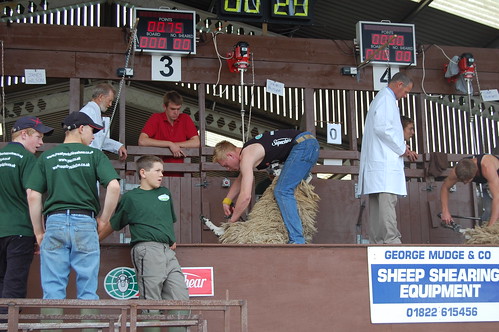
Transworld Sport come in to all of this? For those of you that are not familiar with the television programme, it is the broadest and most global sports broadcast that exists. For instance, the programme I was watching today highlighted the sport of sheep shearing in New Zealand and the Columbian target sport of Tejo (where a lead weight is thrown twenty meters into a box of clay in an attempt to explode a small paper triangle filled with gunpowder). That such obscure activities are showcased indicates that the concept of sport has an ethereal and ambiguous quality. How can sheep shearing possibly be a sport when it is simply a means to an end in gathering wool to provide warmth and comfort? When it is regulated, timed and primarily done to discover who is the fastest, fittest, and most skilled in displacing one object (wool) from an other (sheep). When is a recreational game that was labelled 'the devil's game' and banned due to its association with an alcoholic drink, a sport? When those involved practice for hours every day, embed gym sessions into their routines, wear a team uniform in a formal event that is officiated by a governing body.


Transworld Sport is a wonderfully democratic and inclusive sports programme that doesn't pander to the hegemonic Westernised, male and affluent business conception of sport with which we are bombarded on a daily basis in the similarly hegemonic media. Rather, it reveals a conception of sport that is as broad and as deep as human imagination allows a physically skilful activity that is bounded by rules but done for its own sake, to be.